[Disclosure: This is a sponsored post in collaboration with Emilia Delizia. Photography courtesy of Emilia Delizia.]
I’m a big Italy fan. I first went as a student, marvelling at some of the must-see sights in cities like Rome, Florence and Sorrento. As Jamie and I got into regular ski holidays, we quickly settled on Italy as our favourite place. A ski run is a ski run, maybe, but it was the lunches and dinners that won our hearts, combining the joy of Italian food with the backdrop of snow and mountains. One of our most memorable campervan road trips was to Italy, taking us through Genoa and Cinque Terre to a blissful villa in Tuscany where we spent a week lazing around eating and drinking aplenty.
When it comes to Italy’s food and drink, most people default to pizza and pasta. And yes, those are pretty lovely. But I’ve been lucky enough to experience some of the other elements from this amazing country. I’ve truffle hunted in Rome, I’ve toured vineyards and Prosecco houses in Veneto, and I’ve gazed at what felt like a cathedral of Parmesan in Emilia-Romagna – a region in northern Italy that you might not have heard of, but is basically a food lover’s dream.
Emilia-Romagna is referred to by some as Italy’s ‘Food Valley’, mainly because it’s responsible for some of the country’s most famous culinary exports. Cheese, ham, pasta, balsamic vinegar, wine. They’re all from here. I’ve only dipped my toe in once before and very briefly, but there’s plenty more to see and the good news is, you don’t need weeks to explore this area – you can combine the cities of Bologna and Parma into one trip. Less than an hour apart by train, a trip to both works perfectly for a long weekend that revolves almost entirely around eating. My kind of holiday basically.


Bologna
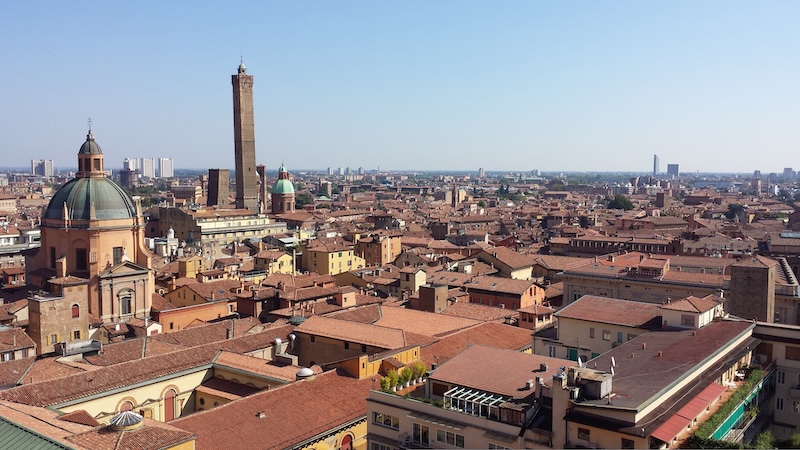
Bologna has a few nicknames. La Rossa means ‘the red one’ and refers to the city’s terracotta buildings, while La Dotta means ‘the learned one’ thanks to its university. Then there’s La Grassa – the fat one. Thanks to its food.
If you’re planning a food-focused trip here, apparently a good place to start is the Quadrilatero, a little network of medieval streets just off Piazza Maggiore that has been at the centre of the city’s food scene for centuries and is packed with traditional shops selling everything from salumi and cheese to fresh pasta.
Of course, there is pasta. Plenty of it too. In Bologna, it’s all about tagliatelle al ragù. Fresh egg pasta, rolled into ribbons and served with a rich, slow-cooked meat sauce. There’s tortellini in brodo, little parcels of stuffed pasta served in a rich broth, and lasagne verdi, made with green spinach pasta, ragù and béchamel.
If you do visit, you should look out for the Bologna tradition of what is known as the sfogline – women (and increasingly men) who make fresh pasta by hand, rolling out huge sheets of dough with long wooden rolling pins before turning them into everything from tagliatelle to tiny tortellini.

You’ve also got to try mortadella if you’re in Bologna, a cured meat that’s probably miles away from anything pre-packaged that you might have had from a supermarket.
To get a proper feel for Bologna’s food scene, a Bologna food tour is a good way to discover some of the city’s specialities and the stories behind them, finding out more about some of these food traditions and stories.
You’ll also be able to take in some of the city’s sights, wandering through historic streets, handsome piazzas and miles of porticoes that have been recognised by UNESCO. They’re also the perfect place to join aperitivo hour with a few snacks. The perfect way to while away some time in a beautiful place.
Parma: Home to famous food
Once you’ve eaten your way around Bologna, it takes less than an hour to get to Parma so you can go for the day or allow a bit more time to really explore.
While Bologna is famous for pasta, Parma is home to a couple of products that need very little introduction.
First up, Parmigiano Reggiano. Our fave addition to pasta dishes, salads, or actually eaten on its own with some aged balsamic. If you’re in Parma you can get yourself to one of the dairies where its made, watching the process, and seeing the vast rooms full of ageing cheeses. Different lengths of ageing time create different flavour profiles, and my suggestion to you is to get your chops around a 24-month aged, as well as a 36-month aged parmesan and see what you think. It’s fascinating – and I still smile at having had the chance to do this.


It’s not just cheese that’s big here. There’s Parma’s namesake – the ham. The hills around Langhirano, just outside Parma, are where the famous Prosciutto di Parma is produced. Hams that are slowly air-dried, with attention paid to the quality of the meat, the salt, the time and the conditions. As with Parmigiano Reggiano, if you’re in this area, you can visit a producer and see how Parma ham is actually made.
We also can’t forget traditional balsamic vinegar, from Modena. The proper stuff made from cooked grape must and aged in wooden barrels for at least 12 years, or 25 years for the extra-aged version. Thick, rich and packed with flavour. Again, visiting a traditional producer in the Modena area is a chance to see the barrels, learn about the ageing process and taste the difference that all that time makes.
As with any Italian region, it’s never just about the food., There’s always the joy of wine too and Emilia-Romagna has plenty of local wines to try.
Lambrusco is probably the best known, although if your memories of it involve rather sweet, cheap bottles from years ago, it’s worth giving it another chance. There are some excellent dry, sparkling versions that work brilliantly with the rich food of the region. Malvasia is another local favourite, particularly around Parma, with aromatic styles that are well worth seeking out.
To explore all of this, you could do far worse than a guided Parma food tour. Emilia Delizia offers tours that take visitors to meet local producers and discover the traditional methods behind the region’s famous foods, without having to worry about finding your own way around.
Planning a foodie weekend in Bologna and Parma
The beauty of combining Bologna and Parma is that you don’t need to spend half your trip travelling. They’re less than an hour apart by train on many services, so it’s perfectly possible to base yourself in Bologna and head to Parma for a day or two.
For a long weekend, you could spend a few days in Bologna exploring the Quadrilatero, eating plenty of pasta and enjoying a leisurely aperitivo or two before heading off to Parma to discover where some of the region’s most famous foods actually come from.
While moving between the cities is super easy, it’s worth bearing in mind that visiting producers is likely to be a bit trickier due to their location. Many of the dairies, ham producers and traditional balsamic vinegar makers are out in the countryside, and given that cheese production starts at the crack of dawn, public transport isn’t always particularly practical. But they’re eminently doable and well worth it.
If, like me, you don’t just love eating and drinking good food and drink but are also fascinated in where it comes from, Emilia-Romagna is kind of the perfect place.
From wandering Bologna’s old market streets with a mortadella sandwich in hand to watching Parmigiano Reggiano being made in the early hours of the morning, it’s a region where food is very much part of the experience rather than just something you fit in around the sightseeing, and the proximity of Bologna and Parma to each other makes for a perfect twin-stop trip.
Just make sure you leave some space in your suitcase for a few edible souvenirs.


